

Most local business owners know they need to show up on Google. What they rarely ask is where they should be on Google, and that question has a real answer with real dollars attached to it. Which is better? The Google Map Pack or organic search results? This debate is not a coin flip. The data points in a clear direction, and once you understand it, you will see exactly why showing up in only one place is costing you calls.
This post gives you the straight answer, backed by numbers, with no vague “it depends” at the end.
How Businesses Show Up on Google Today
Before comparing Map Pack and organic results, it helps to see the full picture. Google’s results page has changed significantly over the past few years. There are now four distinct ways a business can appear, and each one reaches searchers differently.
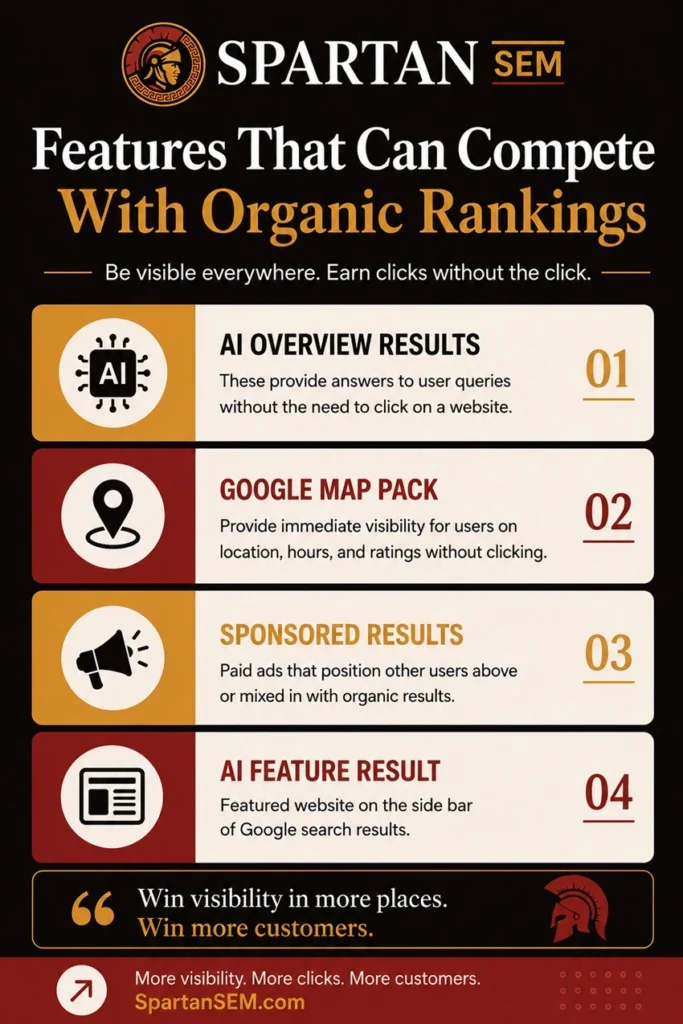
AI Overview Results
AI Overviews appear at the top of many search results and generate a direct answer to the user’s query without requiring a click. For informational searches, this can significantly suppress organic traffic. A searcher who gets their question answered on the results page has less reason to visit any website. For local service businesses, AI Overviews are less of a threat on high-intent queries like “HVAC repair near me”; those still drive clicks and calls.
Where it gets interesting is on the informational side. When Google pulls an AI Overview, it often cites the sources it used to build that answer. If your website is authoritative enough and your content addresses the question clearly, your business can appear as one of the cited sources. The person may never click through. But your name, your brand, and your website URL are visible at the top of the page next to Google’s answer. That kind of passive visibility is harder to measure than a lead, but it does real work on trust over time. It is one more reason that investing in quality content pays off in ways that do not always show up directly in your analytics.
Google Map Pack
The local map pack is the block of three business listings that appears near the top of local search results. It includes a map, star ratings, phone number, hours, and a direct link to the business. For service-area businesses, this is the highest-value piece of real estate on the page. It is covered in depth below.
Sponsored Results
Sponsored results are paid ads that appear above or alongside organic listings. They offer immediate visibility for any keyword you are willing to bid on, which makes them a strong complement to organic and Map Pack efforts, especially for businesses that need leads before their SEO builds traction.
AI Feature Result
The AI Feature Result is a newer placement that surfaces a single featured website in the sidebar of certain Google search results. It is less predictable than the other three and still evolving, but it represents another way Google is reshaping how visibility gets distributed. Businesses with strong authority and well-structured content are better positioned to earn it.
Of these four, the Map Pack and organic results are the two that most directly affect long-term lead generation for local businesses, and the two where a deliberate strategy makes the biggest difference. That is where the rest of this article focuses.
Two Places to Show Up, Two Different Jobs
When someone searches for a local service, the Map Pack and organic results do different work. Understanding what each one does is the starting point for any serious local strategy.
The Map Pack appears near the top of the page and is the first thing most searchers see before they scroll. It is built around proximity, reviews, and business information. It captures people who are ready to act right now.
Organic results sit below it. These are traditional website listings ranked by Google based on content quality, site authority, backlinks, and technical factors. They take longer to earn but build durable, compounding visibility over time. They reach a different kind of searcher, one who is still evaluating options before making a decision.
Both serve different moments in the decision process. Knowing that difference is what separates businesses that capture leads from businesses that just have a website.
What the Data Says About Clicks and Leads
Here is where the conversation gets concrete. According to research by Backlinko, around 42 percent of all clicks on local-intent searches go to Map Pack listings. The top organic result earns roughly 27 percent of clicks. The Map Pack is capturing nearly half of all available attention before a user reaches the first organic link.
The drop-off outside the top three positions is steep. A recent online study found that businesses in the top three Map Pack spots earn 126 percent more traffic and 93 percent more user actions than businesses just outside it. Those actions include calls, direction requests, and website visits, direct lines to new customers for any local service business.
Trust also skews toward the Map Pack. Research cited by Wiremo found that 68 percent of searchers trust Map Pack listings, compared to 27 percent who report the same level of trust for standard organic results. Review counts and star ratings are visible at a glance. That social proof does a lot of the selling before anyone picks up the phone.
When Map Pack Leads Win
For high-intent, immediate searches, the Map Pack is the stronger lead driver. A homeowner who needs an HVAC technician today is not reading blog posts. They are calling the first reputable number they see. That number is almost always in the Map Pack.
Google Maps business leads generated this way tend to have shorter sales cycles, too. The searcher is ready. The Map Pack puts your name, your rating, and your phone number directly in their path at exactly the right moment.
| Factor | Map Pack | Organic Results |
| Share of local clicks | ~42% | ~27% (position 1) |
| Searcher trust level | 68% | 27% |
| Best for | Immediate, high-intent searches | Research-phase searchers |
| Lead type | Calls, direction requests | Form fills, longer research paths |
| Time to results | Weeks to months | Months to a year or more |
| Longevity | Requires ongoing management | Compounds over time |
Where Organic Search Carries Its Weight
Organic results reach a different kind of searcher. Someone comparing businesses and providers, weighing options, or not yet ready to call is far more likely to click on an organic result and spend time on a website. That behavior matters most for higher-ticket services.
A person evaluating local dental offices is not calling the first Map Pack listing. They are reading service pages, checking credentials, and building confidence before they reach out. Organic search vs local pack clicks often breaks down along that line: urgency versus research.
Organic rankings also compound in a way that the Map Pack does not. A well-optimized page can drive traffic for years. That kind of durable visibility is hard to replicate through any other channel. Understanding how rankings translate into actual revenue is the lens every local business owner should apply before deciding where to invest.
The Longer the Decision, the More Organic Matters
Services with longer sales cycles, such as roofing, dental work, physical therapy, and real estate, benefit significantly from a strong organic presence. The potential customer may search multiple times over several days before making a decision. Each time they find your content and your site, trust builds. By the time they are ready to act, the choice often feels like it was already made.

Why the Real Answer Is Both
Asking whether the Map Pack or organic search drives more leads is similar to asking whether your storefront or your reputation matters more. They serve different moments. You need both.
When a business shows up in the Map Pack and holds a strong organic position on the same page, something straightforward happens: the searcher sees the business twice. That double visibility builds credibility before any conversation starts. It signals that this business is established, active, and worth considering. Competitors who appear in only one spot are giving up that advantage every single day.
Businesses that invest in map pack optimization strategy alongside a serious organic presence create a competitive gap that is very hard for others to close. They are capturing high-intent clicks at the top of the page, and research-phase clicks further down. Both contribute to local organic SEO leads in ways that reinforce each other rather than compete.
What It Takes to Rank in Both
The Map Pack and organic results run on different but overlapping signals. Work done for one tends to support the other.
Map Pack Ranking Factors
- A fully completed and actively managed Google Business Profile
- Review volume, recency, and average rating
- Proximity of the searcher to your location
- Consistent business name, address, and phone number across the web
- Overall local authority, which your website contributes to
According to Google, businesses with complete profiles are 2.7 times more likely to be considered reputable by searchers. That single factor alone is enough to move a business from outside the 3-Pack to inside it in competitive markets.

Organic Ranking Factors
- Content quality and relevance to local search queries
- Page structure, headings, and internal linking
- Site speed and mobile performance
- Backlinks from relevant and authoritative sources
- Local keyword relevance on service and location pages
A well-built website also strengthens your Map Pack rankings. Google evaluates your full digital footprint when determining local authority. A slow, thin website drags down both your organic positions and your chances of staying in the top three Map Pack spots.
Can a business rank in the Map Pack and in organic results at the same time? Yes, and doing so is one of the most effective visibility strategies available to any local business. Appearing in both places on the same results page compounds trust and substantially increases the odds that a searcher calls you instead of a competitor.
What This Looks Like in Spartanburg
In a market like Spartanburg, the businesses building both right now are pulling ahead of competitors who are still focused on just one. Service industries here are competitive, and the gap between businesses with complete local visibility and those without is widening every month. Our Spartanburg SEO services are built around exactly this kind of full-presence strategy, Map Pack and organic, working together.
The same is true in Greenville, where search competition across business types has increased sharply. Businesses that show up once are competing. The ones that show up twice are winning.
The Businesses Winning Local Search Show Up Twice
Map pack vs organic SEO is not a choice between two competing strategies. It is two parts of the same goal: being visible when a local customer is ready to make a decision. The businesses earning the most calls and clicks are not picking a lane. They have built both, and the compounding effect shows up in their pipeline.
The data is clear. The Map Pack drives immediate, high-intent leads. Organic search captures the researchers and builds long-term authority. Together, they cover the full spectrum of how local customers find and choose a business. Apart, each one leaves money on the table.
Are You Leaving Money On The Table?
Make sure your business is visible wherever your customers are looking. Those who show up have a voice in the conversation. Those who don’t are left behind.