

If your phone rings, jobs are getting done, and your business is moving, it’s easy to assume your website isn’t a priority. Some home service contractors and businesses rely on a basic site that hasn’t been updated in years. Others link their Google listing to a social media page and treat that as their online presence.
Early on, that can be enough to get by.
Over time, though, “good enough” online starts to cost you job opportunities in ways that aren’t always obvious.
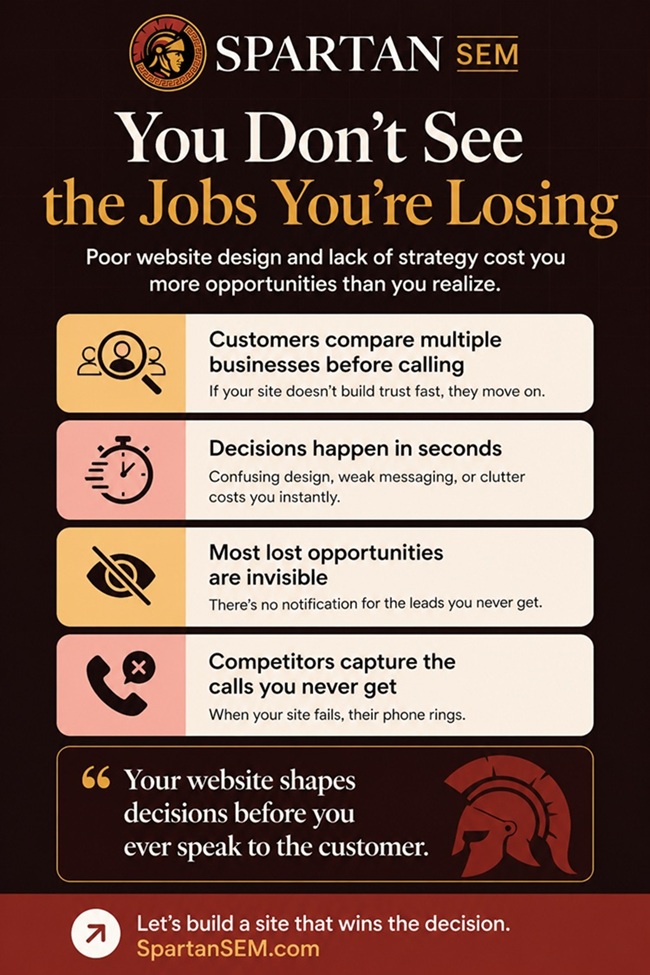
Customers compare multiple contractors before they call. They decide who looks established, who feels trustworthy, and who seems easiest to work with. That judgment happens quickly, often in a matter of seconds.
A cheap or outdated website does not just sit there. It shapes how your home service business is perceived, how often you get contacted, and the type of jobs you attract.
You do not see the calls you did not get or the customers who chose someone else. The impact is still there, and it adds up over time.
A Cheap Website Doesn’t Save Money, It Limits What You Get Back
A lower-cost website usually feels like a smart decision at the time. It gets your roofing, plumbing, or HVAC business online without a large upfront investment.
The issue is not the initial cost. It is what that decision limits afterward.
A basic or outdated site often:
- converts fewer visitors into calls
- attracts lower-intent traffic
- makes it harder to compete with stronger competitors
This creates a gap between the work you are capable of doing and the work you actually get.
The difference shows up in the types of jobs coming in. Lower-quality sites tend to attract more price-shopping and fewer higher-value opportunities. Over time, that changes the direction of the business.
Saving money up front can end up reducing what your marketing produces over the long term.
When Your “Website” Isn’t Actually a Website
Some home service businesses are not just underinvesting in their website. They do not really have one.
Instead, their Google Business Profile links to a social media page or a placeholder site with limited information.
A Social Media Page Is Not a Foundation
A social media page can help you get started. It gives people a way to find your business, see recent work, and get a basic sense of what you do. It is not built to support how customers search or how businesses grow over time.
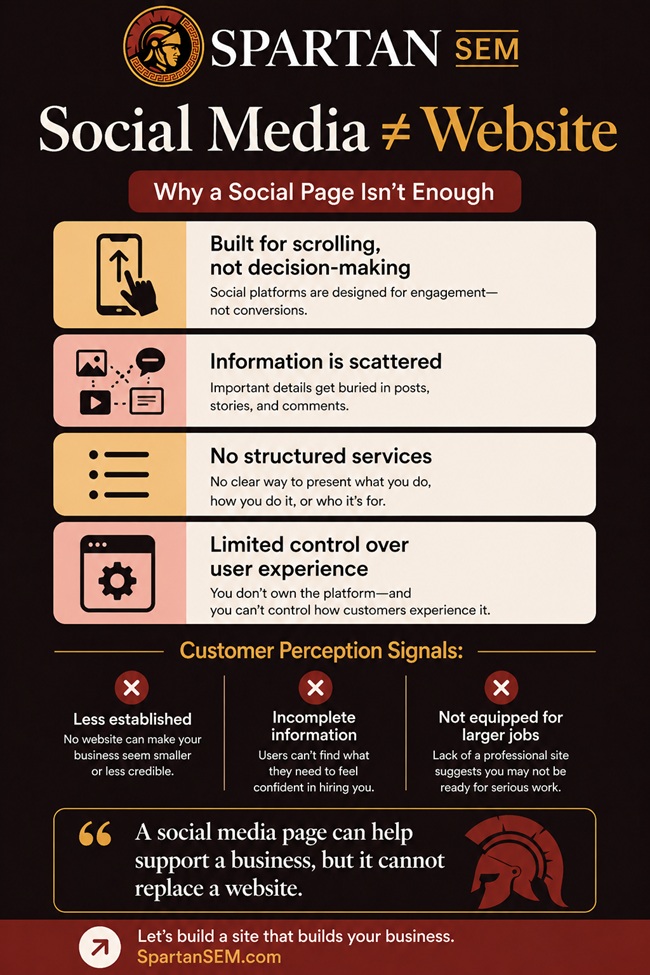
Social platforms are designed for scrolling, not decision-making. Information is scattered across posts instead of being organized in a way that helps someone quickly understand your services, where you work, and how to take the next step.
There is no real structure. Services are not clearly separated. Important details can be buried or outdated. You also have limited control over how content is displayed and how users move through it.
As your business grows, those limitations become more noticeable. What worked early on starts to create gaps in how your business is presented, especially when customers are comparing multiple companies before making a decision.
What It Signals to Customers
Customers use your online presence to decide who to contact.
A social media page or bare-bones website can signal:
- the business is newer or less established
- information may be incomplete
- the company may not handle larger or more complex jobs
That matters more as job value increases.
A homeowner looking for a quick roofing or plumbing repair may not think twice. A property owner planning a larger HVAC project will.
If your goal is to grow, your online presence needs to reflect that. A social media page can help support a home service business, but it cannot replace a well-built website.
Customers Are Comparing You, Even If You Don’t Realize It
Not all customers contact the first company they see. They look through multiple options, scan each website for their answer, and they compare how each business presents itself. Who looks more trustworthy, who looks more professional, and who seems to have more satisfied customers?
Within seconds, they form an impression based on:
- how the site looks
- how easy it is to understand and navigate
- how quickly they can find what they need
Even if your service is stronger, your website can work against you if it does not present that clearly. If you don’t have a website or your site is dated, incomplete, or poorly functioning, you might be removed from that consideration altogether.
Where Cheap Home Services Websites Lose Jobs
The impact of a weak website does not show up all at once. It shows up in small moments where a customer decides to move on instead of reaching out.
Those moments add up.
Poor Mobile Experience
Most home service searches happen on mobile devices.
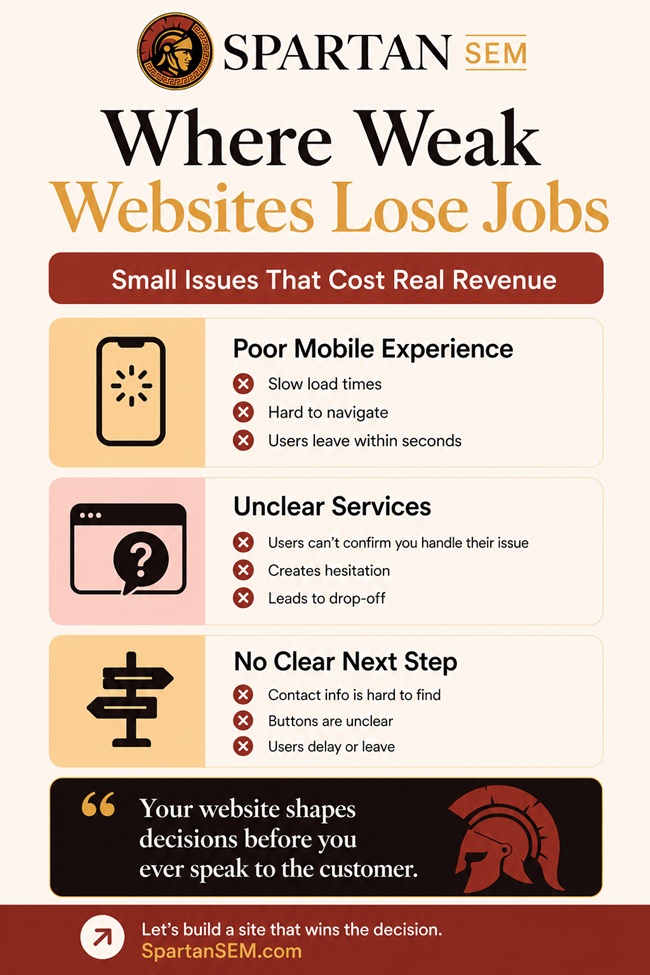
If your site loads slowly, feels cramped, or is difficult to navigate, users leave quickly. They move to the next option and contact someone else.
This is not a long decision process. It happens in seconds, often before a user even scrolls. A site that does not work well on mobile loses opportunities before your services are ever considered.
Unclear Services
When services are not clearly outlined, users have to figure out whether you can help them.
That creates hesitation.
Most customers are not willing to search through a site to connect the dots. They are looking for confirmation that you handle their specific issue. If they cannot find that quickly, they move on to a company that makes it obvious.
This is especially important for higher-value jobs, where customers want to feel confident they are contacting the right provider.
No Clear Next Step
A website should guide users toward contacting you.
If the next step is not obvious, users delay or leave. Even small barriers, like hard-to-find contact information, unclear buttons, or layouts that make users think too much, reduce the likelihood of a call.
Many businesses assume that if someone is interested, they will reach out anyway. In reality, most users choose the option that feels easiest in the moment.
Each of these issues may seem minor on its own. Together, they change how often your site turns visitors into calls and how consistently your website produces leads.
It Doesn’t Support SEO or Paid Ads for Home Contractors
A weak website does not just affect direct traffic. It limits everything connected to it.
Search visibility depends on structure. If your site does not clearly separate services or support how people search, it becomes harder to rank.
Paid ads depend on alignment. If someone clicks on an ad and lands on a page that does not match what they were looking for, they leave.
That leads to:
- lower rankings
- higher cost per lead
- less return from your marketing
A stronger website improves how both SEO and paid campaigns perform. Without that foundation, both become less effective.
The Contractor Jobs You Lose Are the Ones You Don’t See
The biggest issue with a weak website is that the losses are not obvious.
You do not see:
- the customers who left after a few seconds
- the people who chose a competitor’s site
- the opportunities that never turned into calls
There is no notification for a missed job.
Over time, though, those missed opportunities create a gap between where your business is and where it could be.
Your competitors benefit from that gap. They capture the calls you did not.
A Better Website Doesn’t Just Look Better, It Performs Differently
A strong website changes how your business operates.
It makes it easier for customers to:
- understand what you do
- trust your business
- take the next step
It also supports your marketing by:
- improving search visibility
- increasing conversion rates
- making paid campaigns more efficient
Websites are more than just a visual component. They are the most direct path to turning a potential customer into a client.
Who Websites Matter Most For
A well-built website matters for any roofing, plumbing, or HVAC business trying to grow, but the impact becomes much more noticeable at certain stages.
This is especially true for:
- Companies that want more consistent lead flow
If your calls depend heavily on referrals or seasonal swings, your website plays a larger role in stabilizing that. A stronger site helps turn search traffic into a more reliable source of work. - Businesses looking to move into higher-value jobs
As job size increases, so does scrutiny. Customers are more selective about who they contact. Your website often becomes part of that decision, even if you are already well-qualified for the work. - Contractors investing in marketing without strong results
If you are spending money on SEO, paid ads, or other marketing efforts, your website directly affects what those efforts produce. A weak site limits the return, regardless of how much traffic you generate.
At a certain point, a basic website stops being enough. What worked when the business was smaller starts to create limitations.
If your business is growing, your website needs to grow with it.
What This Means for Your Business as a Home Services Contractor
A website is not just something your business has. It is part of how your business operates.
It shapes how customers see you, how often you get contacted, and the type of work you attract.
A cheap or outdated site limits those outcomes. A stronger one improves them.
The difference is not always obvious day to day. Over time, it becomes significant. More of the right customers find you, more of them reach out, and your marketing starts to produce more consistent results.
If your website is not doing that, there is usually a clear reason behind it.
At Spartan SEM, we focus on building websites that support how home service businesses actually grow, not just how they look online. If you want to understand where your current site is falling short and what can be improved, the next step is a straightforward review of how it is performing today.