

Why Search Visibility Plays a Major Role in Patient Discovery
Orthopedic practices operate in one of the most competitive areas of healthcare. Patients searching for treatment options for knee injuries, shoulder pain, sports injuries, or joint problems often begin their journey online, using Google to find nearby providers, research symptoms, and compare clinics.
For many independent orthopedic clinics and surgical groups in Spartanburg, this creates a frustrating reality. Hospital systems and large healthcare networks frequently dominate search results, even when private practices offer highly specialized care, shorter wait times, or more personalized treatment.
Local SEO for orthopedic practices addresses this challenge directly. Instead of relying on broad advertising or generic marketing strategies, search optimization focuses on helping orthopedic clinics appear in the exact searches patients make when they are actively looking for care.
When implemented strategically, local SEO helps orthopedic surgeons and specialty clinics increase visibility in Spartanburg search results, connect with patients who are actively seeking treatment, and compete more effectively with larger healthcare organizations that traditionally dominate online visibility.
Understanding how orthopedic patients search, and how local SEO positions your practice in those searches, is the first step toward building a digital presence that consistently attracts qualified new patients.
How Patients Search for Orthopedic Care Today
The way patients find orthopedic care has changed significantly over the past decade. While referrals from primary care physicians, urgent care centers, and physical therapists still play an important role, many patients now begin their healthcare journey with an online search.
When someone experiences persistent joint pain, a sports injury, or mobility limitations, their first step is often to research symptoms and potential treatment options. From there, the search typically becomes more specific as patients begin looking for providers who can evaluate and treat their condition.
For orthopedic practices in Spartanburg, this search behavior creates a clear opportunity. Patients are already searching for answers, and local SEO helps ensure that your practice appears when those searches happen.
Symptom-Based Searches
Many orthopedic journeys begin with symptom searches such as:
- knee pain treatment
- shoulder pain doctor
- ankle injury treatment
- hip pain specialist
- back pain doctor near me
These searches often represent early-stage research. The patient may not yet know the exact condition they are dealing with, but they are actively looking for information.

Condition-Based Searches
As patients continue researching, their searches often become more specific:
- ACL tear treatment
- rotator cuff injury specialist
- meniscus tear treatment
- carpal tunnel doctor
At this stage, the patient is no longer just researching symptoms. They are starting to look for providers with expertise in treating specific orthopedic conditions.
Provider and Location Searches
The final stage of many patient searches focuses on selecting a doctor or clinic. These searches often include geographic modifiers such as:
- orthopedic surgeon Spartanburg
- orthopedic clinic near me
- sports medicine doctor Spartanburg
When patients reach this stage, they are typically close to scheduling an appointment.
What Orthopedic Search Demand Looks Like in Spartanburg
Local search data shows that orthopedic care is actively researched by patients in the Spartanburg area.
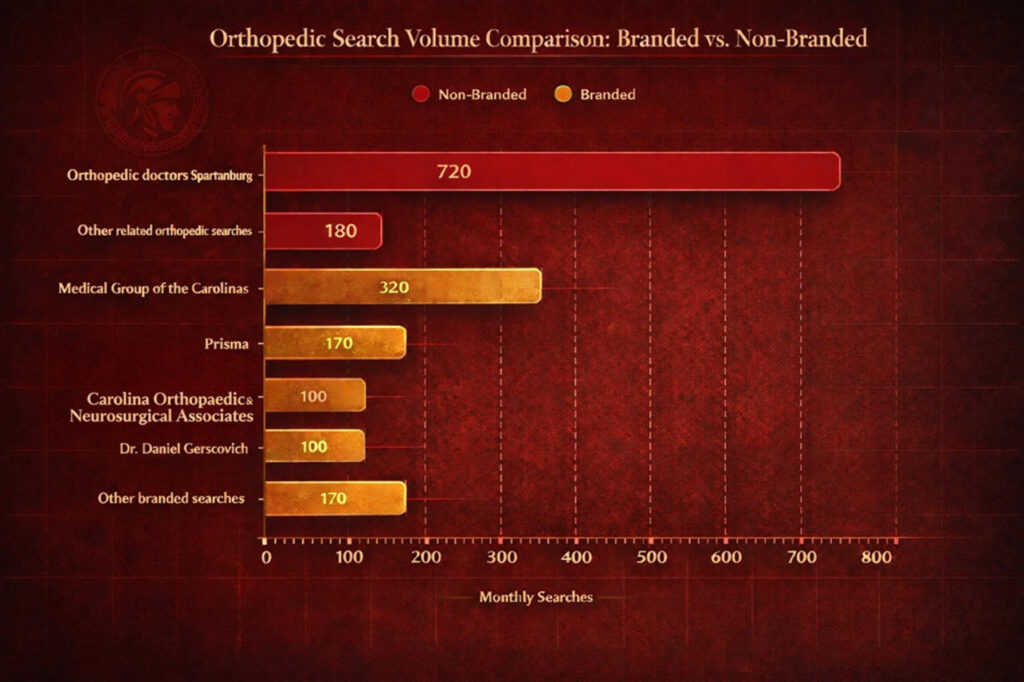
Across eleven common orthopedic service searches—including phrases such as orthopedic specialist Spartanburg, sports medicine clinic Spartanburg, and orthopedic surgeon Spartanburg—total non-branded search demand exceeds 900 searches per month.
These searches represent patients who are actively looking for orthopedic care but have not yet chosen a provider.
One of the highest-volume searches in the area is:
“Orthopedic doctors Spartanburg” — approximately 720 searches per month.
For orthopedic clinics, this type of search represents extremely strong patient intent. The person searching is not casually browsing medical information. They are actively trying to find a physician.
Beyond these general searches, patients also search for treatment-specific procedures and injuries, including:
- knee replacement
- ACL reconstruction
- rotator cuff surgery
- hip replacement surgery
Each of these searches represents individuals who may soon require orthopedic evaluation or surgical consultation.
Who Appears in Spartanburg Orthopedic Search Results
When analyzing orthopedic-related searches in Spartanburg, several organizations consistently appear in top organic results and Google’s map listings.
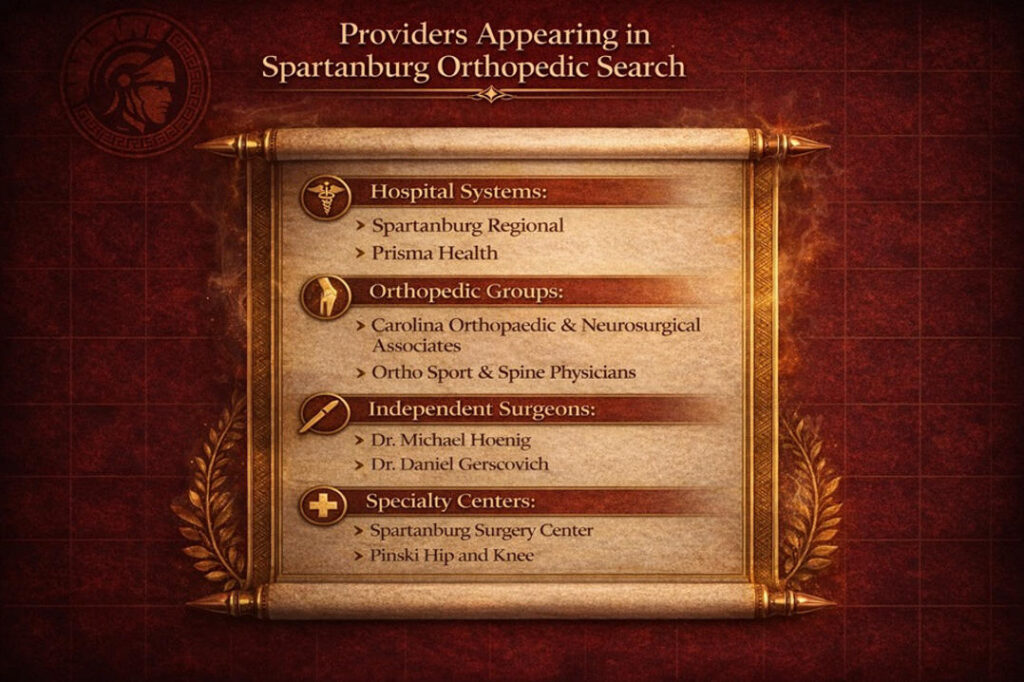
The providers most frequently appearing in search results include:
- Spartanburg Regional Healthcare System
- Prisma Health
- Carolina Orthopaedic & Neurosurgical Associates
- Ortho Sport & Spine Physicians
- Dr. Michael Hoenig
Large healthcare systems such as Spartanburg Regional and Prisma Health regularly appear in positions one through three for many high-volume searches.
However, additional providers appear when searches become more treatment-specific.
For procedure-related searches such as ACL reconstruction, knee replacement, and rotator cuff surgery, additional physicians and facilities often appear in search results, including:
- Dr. Daniel Gerscovich
- Dr. Michael Le
- Spartanburg Surgery Center
- Pinski Hip and Knee
This search pattern illustrates an important point. While hospital systems often dominate broader healthcare searches, independent orthopedic surgeons and specialty practices can gain visibility through targeted search optimization around specific treatments and procedures.
Directory websites also appear frequently in orthopedic search results. Platforms such as Yelp, U.S. News Health, and Healthgrades often rank for provider-related searches, which can further limit visibility for individual clinics.
Why Page-One Rankings Matter So Much in Healthcare Search
When patients search for healthcare providers online, most of them choose from the first few results they see.
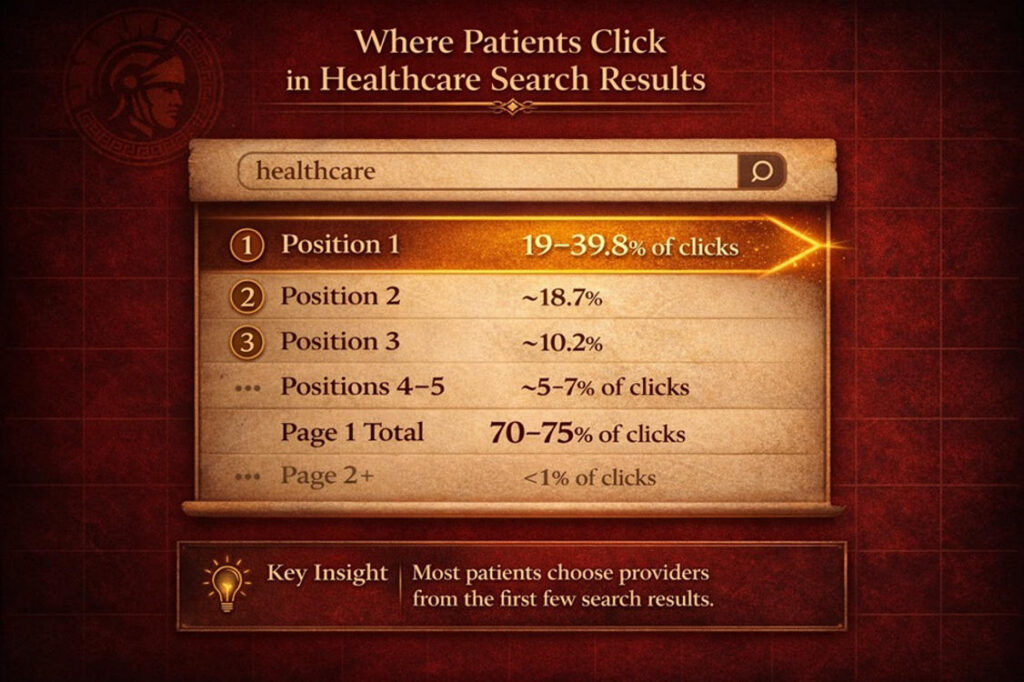
Studies of healthcare-related searches show that the top result on Google typically receives between 19% – 28% of all clicks. First position can see nearly 40% of all clicks if featured in an AI snippet. The second and third results usually receive about 10% to 18% of clicks, while listings further down the page receive far fewer.
In total, about 70% to 75% of all clicks happen on the first page of Google results. Pages that appear on the second page of search results receive less than 1% of clicks.
For orthopedic practices, this has a direct effect on how many patients discover a clinic online.
For example, the search “orthopedic doctors Spartanburg” is performed about 720 times per month.
If a practice ranks near the top of the page for that search, it could receive well over 100 website visits each month from that search alone. A practice ranking a few positions lower might receive 50 to 100 visits.
However, a clinic that appears on the second page of search results may receive only a handful of visits—or none at all.
Those differences matter because some of those visitors eventually become patient inquiries.
Across healthcare websites, typical conversion rates range from about 2% to 5%. That means every 100 visitors could result in two to five potential patient inquiries, depending on how easy it is to contact the clinic or schedule an appointment.
When this happens across many different searches, such as ACL reconstruction, knee replacement, rotator cuff surgery, and sports injury treatment, the difference in visibility can significantly affect how many new patients find a practice.
Even small improvements in search rankings can lead to noticeably more patients discovering a clinic during their search for orthopedic care.
Why Google Map Listings Are Critical for Orthopedic Clinics
For healthcare searches with local intent, Google often displays a local map pack that highlights nearby clinics.
These map listings frequently capture 17% to 24% of total search clicks, making them one of the most valuable visibility opportunities for medical practices.
Across the Spartanburg orthopedic searches analyzed, several providers appeared repeatedly in both organic search results and the local map pack.
Practices that appear in both locations benefit from significantly greater visibility during the patient research process.
What Happens After a Patient Visits a Healthcare Website
Search visibility helps patients discover a clinic, but website performance determines whether that visitor becomes a patient inquiry.
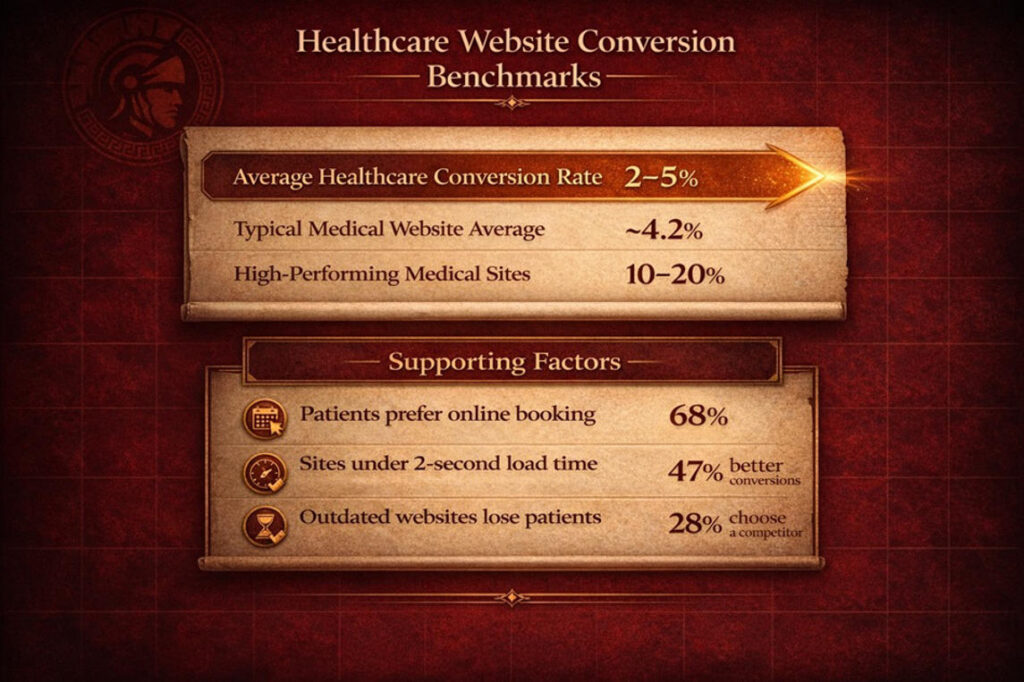
Across the healthcare industry, website conversion rates typically range between 2% and 5%, with approximately 4.2% representing a common average for medical practices.
Top-performing websites can achieve conversion rates exceeding 10%.
Several factors influence whether a visitor schedules an appointment, including:
- website speed
- mobile usability
- appointment scheduling availability
- clear contact options
Research also shows that 68% of patients prefer providers that offer online appointment scheduling, and websites that load in under two seconds can convert 47% better than slower websites.
Patients also pay attention to trust signals. Updated websites, physician information, and patient-focused content all influence whether someone chooses one clinic over another.
What This Means for Orthopedic Practices in Spartanburg
When these data points are viewed together, a clear pattern emerges.
Hundreds of patients search for orthopedic care in Spartanburg each month. A relatively small group of providers consistently captures the majority of search visibility, and most clicks occur among the first few search results.
At the same time, patient decisions are influenced by website experience, appointment accessibility, and trust signals once they visit a provider’s website.
For orthopedic clinics and surgeons, this means that search visibility plays a significant role in determining which practices patients discover during their research process.
Local SEO strategies help orthopedic practices improve visibility for the searches patients are already performing, allowing clinics to connect with individuals who are actively looking for treatment.
For practices serving the Spartanburg area, improving visibility in these searches can significantly influence patient discovery and long-term practice growth.
How Does Your Practice Hold Up?
How many patients are missing your business?
Data & Methodology
The insights presented in this article are based on a combination of local keyword research, search result analysis, and healthcare marketing benchmarks.
Local search demand was evaluated by reviewing common orthopedic-related queries in the Spartanburg, South Carolina market, including searches such as “orthopedic doctors Spartanburg,” “orthopedic specialist Spartanburg,” “sports medicine clinic Spartanburg,” and “orthopedic surgeon Spartanburg.” Monthly search volume data was used to estimate the level of patient demand for orthopedic care in the region.
Organic search results and Google map listings were reviewed across these queries to identify which providers appeared most frequently in top positions. This analysis also noted the presence of directory platforms such as Yelp, U.S. News Health, and Healthgrades, which often occupy search positions alongside provider websites.
Additional review included treatment-specific searches such as knee replacement, ACL reconstruction, rotator cuff surgery, and hip replacement surgery to observe how visibility changes between general orthopedic searches and procedure-focused queries.
Healthcare click-through rate and website conversion benchmarks referenced in this article are based on aggregated industry research and publicly available studies examining performance trends across medical and healthcare websites. These benchmarks illustrate common performance ranges for healthcare organizations, though individual results may vary depending on local competition, website quality, and overall marketing strategy.